
Vacation in Croatia: Travel to the Sea by car

In recent years, Croatia has developed into one of the most popular travel destinations for families and individual tourists in Europe. Especially for all those who drive to Croatia. If you want to drive, there are numerous advantages: you have flexible time, you can carry more luggage and go to places off the beaten tourist path. But how do you plan such a trip optimally to avoid stress and experience as much of the country and its people as possible?
Execute this technical instructions should cover all the important aspects for your Croatia vacation with self-arrival – from travel routes, travel costs, fuel tips to the best travel times to avoid traffic jams.
Key Takeaways

Croatia boasts stunning coasts, historic cities, lush nature, and vibrant culture.

Croatia’s tourist infrastructure has grown with improved highways, shopping, medical centers, and leisure options.

Driving from Germany to Croatia requires an ID/passport, driver’s license, registration, and insurance proof.

Tolls and vignettes apply via Austria, Slovenia, and on select motorway sections in Italy and Croatia.

Croatia’s tolls are distance-based and payable by cash or credit card.

Driving offers flexibility to explore diverse landscapes and rich culture.
What makes Croatia so attractive as a travel destination by car?
A diverse country with fantastic cuisine
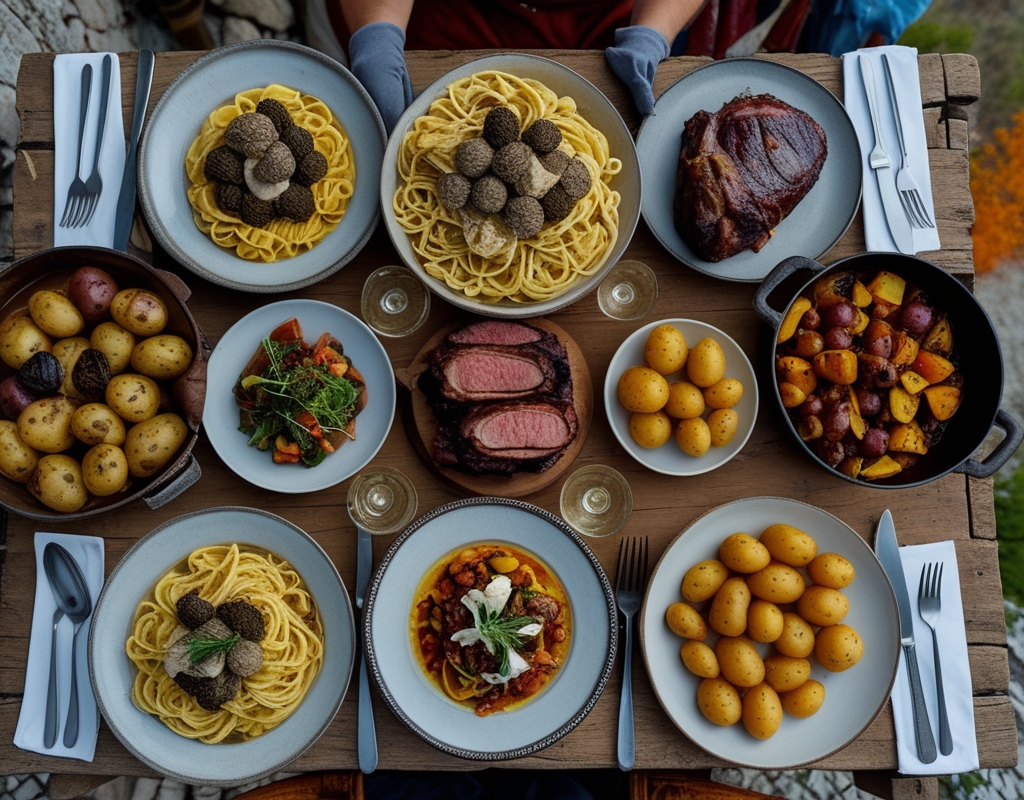
Croatia offers an interesting mix of idyllic coasts, historic cities, varied nature and a fantastic culture with a traditional local cuisine. Regardless of truffles Fuži (traditional pasta with truffles from the region) or a meat specialty from Peka (the meat is prepared in a “cast iron roaster” covered with hot ash) to the popular Mangold potatoes (mashed potatoes with chard and garlic). Your gourmet heart will definitely beat faster.
Idyllic beaches and charming history

Along the Adriatic coast there are countless beaches and secluded bathing bays, as well as wild and romantic rocky shores, most of which can only be reached by car. Charming historic villages (such as Pićan in Istria) and some of the best local restaurants serving traditional cuisine tend to be located inland. So if you love variety and want to enjoy the beauty of Croatia to the fullest, you can’t avoid traveling to Croatia by car. Depending on where exactly you are planning your holiday in Croatia, the public transport network is not well developed everywhere.
Croatia is still very inexpensive
Croatia is well embedded in Europe and can therefore be easily and inexpensively reached by car from many countries. Not to be forgotten, it is still a good value for money compared to some western neighboring countries such as Italy, France & Co.
Versatile tourism infrastructure
The tourist infrastructure in Croatia has been intensively expanded in recent years. Many highways and streets have been modernized. In many places, everyday shopping can be done in well-known supermarkets and large discounters, from 7 a.m. to 10 p.m. during the summer months. In some areas there were even own medical center fSet up for tourists with German-speaking doctors. There is a wide range of restaurants and bars and, in addition to water sports, there are a variety of leisure activities on offer. (There is a lot from quad tours to visits to the zoo or paintball) Campsites meet international standards and there is a large selection of hotels, villas and apartments.
According to the Croatian Tourism Association, Croatia recorded over 18 million foreign visitors in 2022. This trend shows that the country is no longer an insider tip but has developed into an integral part of European tourism.
Travel preparations for the road trip to Croatia

Documents and vehicle papers
Travelling from Germany to Croatia by car usually requires the following documents:
- ID card or passport: Croatia is part of the EU, but there are controlled borders.
- Driver’s license: The EU driving license is sufficient.
- Registration papers (vehicle license): Must be presentable at all times.
- Proof of insurance: The green insurance card is no longer mandatory, but is recommended.
Tolls and vignettes
Vignettes are required for arrival via Austria and Slovenia. In Italy and Croatia there is a route-dependent toll on certain motorway sections. Fees vary depending on the distance traveled.
Austria
There are vignettes for 10 days (€12.40), 2 months (€31.10) or the annual vignette (€103.80). These vignettes are available either online via the official website of the motorway company in Austria (ASFINAG), as well as at border crossings or gas stations.
Danger: Depending on which travel route you choose, an additional route or special toll applies for certain routes in Austria. At the same time, the usual vignette requirement no longer applies on routes with special tolls.
- A9 Pyhrn motorway (Gleinalm and Bosruck tunnel: € 18.50)
- A10 Tauernautobahn (Tauern-/Katschbergtunnel: € 14,50)
- A11 Karawankenautobahn (Karawankentunnel: € 8.80)
- A13 Brenner motorway (€16)
- S16 Arlberg expressway (Arlberg tunnel: € 12.50)
Slovenia
There are also vignettes for 7 days (€16), 1 month (€32) or the annual vignette (€117.50). You can also obtain the Slovenian vignette either online from the official website of the Slovenian motorway company (LESSON), or in gas stations, as well as at border crossings.
Croatia
The toll in Croatia is calculated based on the distance traveled. For a normal car you can expect tolls of around €8.00 per 100 km. The exact cost depends on the exact route and possible seasonal price changes. The toll is paid at toll stations along the highway. You can pay in cash or by credit card. From 2025, Croatia plans to additionally introduce a digital system with an e-vignette or digital toll box.
Italy
In Italy, the toll costs are calculated per kilometer driven. The motorway toll in Italy costs an average of around 7 cents per kilometer for a normal car. However, the exact cost can vary depending on the route and region, especially in mountainous areas where fees are often higher. The toll in Italy is mainly charged according to the closed system: When you enter the motorway, you receive a ticket at a toll station. When you leave, you pay the toll based on the route traveled and your vehicle type. There are various payment options: cash or credit card at the white lanes of the toll booths. Electronic payment systems such as Telepass, which allow faster transit. Since 2025, there has been an electronic system with license plate recognition (free flow system) on some motorways, such as the A33 near Asti and the A36, A59 and A60 near Como. It is important to note that you should keep the toll ticket. In the event of a loss, the highest possible fee is usually due
Insurance and vehicle check before you leave to Croatia
Before you leave, check the condition of your vehicle: oil level, tire pressure (including spare tire), lights, windshield washer fluid and coolant.
One Mobility guarantee or a letter of protection as part of your car insurance provides additional security.
We also recommend checking whether there is one for you and your fellow travelers personal travel protection abroad. When abroad, not only your car, but also you and your loved ones should be insured in the event of a hospital stay or for possible medical repatriation to your home country.
Attention: Medical repatriation is generally not insured under statutory or semi-private health insurance. Anyone who has foreign travel and health insurance through their credit card is usually only insured if they have expressly paid for the trip with their credit card.
Checklist for your Croatia vacation by car
If you are looking for a structured overview, you can print out or store this short checklist digitally:
|
|
Travel documents | Identity cards, driving licenses, vehicle documents |

|
Vignettes & tolls | Get it in advance or buy it at rest stops |
|
|
Autocheck | Tires, fluids, brakes, lights |

|
Insurance |
Letter of protection, international health and international travel insurance. If necessary, telephone number for the breakdown service. |

|
Navigation | Carry out navigation updates, plan itinerary |

|
Emergency kit | Warning triangle, safety vests, first aid kit |

|
Documents for accommodation | Travel documents, booking confirmation, Host or hotel phone number |

|
Travel provisions and drinks | If there is a traffic jam, no one should have to stay thirsty or hungry |

|
Entertainment for the children | Travel games for the car or downloading offline content to your tablet |
Route planning: From Germany to Croatia by car
The choice of route depends largely on your starting point. Most travelers come from southern Germany, Austria or Switzerland.
Main routes
-
Route via Austria and Slovenia
* Ideal for travelers from southern and central Germany.
* The most frequently traveled route because it is comparatively short.
* Main axis: Munich – Salzburg – Villach – Ljubljana – Croatia -
Route via Italy (Brennero) and Slovenia
* For travelers who may want to make a stopover in Northern Italy.
* Main axis: Munich – Innsbruck – Brenner – Bolzano – Verona – Trieste – Slovenia – Croatia. -
Alternative: long-distance routes via Hungary
* Used less often, especially for destinations in eastern Croatia or if you want to avoid the metropolitan areas in Slovenia and Austria.
* Main axis: Vienna – Bratislava (Slovakia) – Hungary – Croatia
Border crossings to Croatia with less traffic jams
- Bypass the Karawanken Tunnel: Instead, the route over the Wurzenpass or Loiblpass
- Slovenia-Croatia: Many people use the “Obrežje/Bregana” border crossing (Zagreb – Ljubljana motorway). Smaller border crossings such as “Metlika/Jurovski Brod” are less frequented if the destination is in northern Croatia.
- Italy-Slovenia: As an alternative to Trieste, there are smaller crossings such as “Fernetti” or “Pesek”.
Ideal travel times to Croatia by car
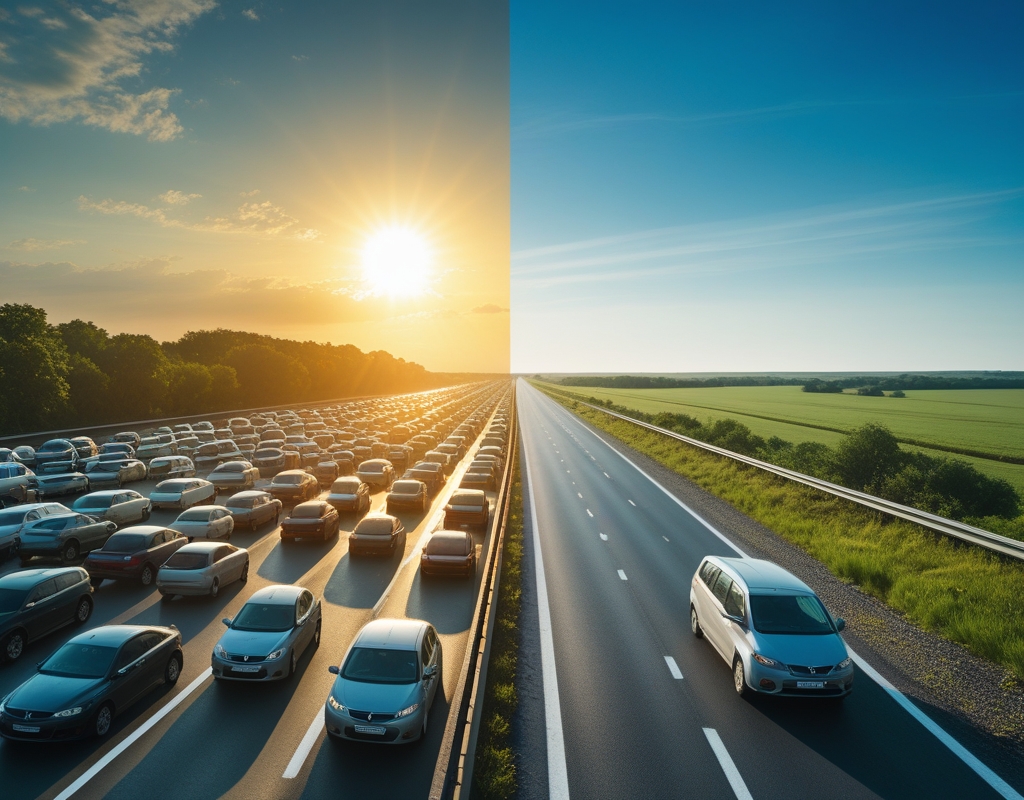
For those traveling by car from Germany to Croatia, planning your trip during early summer (April to June) or late summer (September to October) is ideal. During these periods, you benefit from pleasant temperatures, fewer tourists, and lower accommodation prices, and you’re likely to avoid heavy traffic on your way to your holiday home.
If these timeframes don’t work for you, another option is to carefully schedule your departure. Leaving in the late afternoon of the previous day or starting as early as 4:00 a.m. can help you avoid the typical bottlenecks, such as congested cities, tunnels, and border crossings, that are common during peak travel times.
Of course, driving through at night or in the dark is not for everyone. Maybe you can take turns traveling with your fellow travelers. Or you can take a short break for a power nap after the first section. (As a rule, a power nap should not last longer than 10 – 20 minutes to feel fully recovered)
Either way, “Safety first” is the motto.
And don’t worry if you arrive at your holiday accommodation far too early due to the early start of your trip. Even if check-in can’t happen until late afternoon, your early arrival offers many wonderful opportunities to explore the area, have culinary experiences or simply enjoy time on the beach sunbathing and swimming.
In summary:
* Travel in the low season if possible (April to June or September to October)
* Travel as anti-cyclically as possible during high season (Avoid Saturday or Sunday for arrival or departure)
* Driving at unusual times (plan your journey so that you don’t pass the bottleneck at prime time)
Reach your destination in Croatia Relaxed and Stress-free

Drive stress-free
Families with small children especially appreciate frequent breaks. Plan enough time for stops. Take enough drinks and snacks with you for your journey. And if the impatience, especially for children, becomes too great and the sentence: “Are we there yet” echoes from the back seats, then be as well prepared as possible.
For example, depending on the age of the children, with coloring books, travel bingo, audio books, magnetic board games or even their favorite film on the tablet.
Relaxed children usually also mean relaxed parents.
Combine alternative means of transport
If you’d like to cover part of your route by train, you can take a car train from Germany to Villach in Austria, and then drive the remaining distance to Croatia. Although this option is on the expensive side—starting at around €648 for a family of four (2 adults, 2 children under 6, plus a car)—it can significantly reduce the fatigue and stress of long-distance driving.
Where is it cheapest to refuel?
Petrol and diesel prices in comparison
Fuel prices vary greatly between Germany, Austria, Slovenia and Croatia. As a rule, fuel in Austria is cheaper than in Germany, while Slovenia and Croatia are usually at a similar level or slightly lower.
Based on the provided table of fuel prices in various European countries, sourced from de.statista in November 2024, here are some useful takeaways for travelers planning a journey to Croatia. The table lists diesel prices as follows: Slovenia at €1.50 per liter, Croatia at €1.61 per liter, Austria at €1.63 per liter, Germany at €1.64 per liter, and Italy at €1.75 per liter. For petrol (Eurosuper 95), the prices are: Slovenia at €1.47 per liter, Croatia at €1.60 per liter, Austria at €1.63 per liter, Germany at €1.78 per liter, and Italy at €1.87 per liter. These price variations offer strategic opportunities to save money on fuel during your trip.
For those driving to Croatia, it pays off to refill your tank in Slovenia, where both diesel and petrol prices are the lowest among the listed countries. For example, filling a 50-liter tank with diesel in Slovenia costs €75, compared to €87.50 in Italy, saving you €12.50 per tank. The savings are even greater for petrol, with a full tank costing €73.50 in Slovenia versus €93.50 in Italy, a difference of €20. Therefore, it’s highly advisable to avoid refueling in Italy, where fuel prices are significantly higher. Even compared to Austria and Germany, Slovenia offers savings—€6.50 per tank for diesel and €8 per tank for petrol when choosing Slovenia over Austria. If you must refuel in Croatia, prices are still lower than in Austria, Germany, and Italy, making it a better option than those countries, though not as economical as Slovenia. Since fuel prices can fluctuate, checking current rates before your trip is recommended, but based on this data, prioritizing Slovenia for refueling will minimize your costs on the journey to Croatia.
Means of payment
The euro has been the official means of payment in Croatia since 2023. Gas stations usually accept major credit cards such as Visa or MasterCard. There are plenty of ATMs for cash withdrawals. However, you should still carry cash reserves in case terminals fail or smaller gas stations do not accept cards.
How much does it cost to travel from Germany to Croatia by car?
A flat rate cannot be given as factors such as place of residence or distance traveled, vehicle type, fuel consumption and toll routes vary.
For our example calculation we assume the following facts:
- Route: Munich – Salzburg – Villach – Ljubljana – Croatia (Labin in Istria), so in total 575 km Route
- Average diesel consumption: 7 liters per 100 km
- Diesel costs: 1,64 €/Liter
| Cost Type | Description | Amount (€) |
|---|---|---|
| Fuel costs | 40.25 L * 1.64 €/L | 66.01 |
| Toll: Austria Vignette | 10-Day Vignette | 12.4 |
| Toll: Karawankentunnel | Tunnel toll | 8.8 |
| Toll: Slovenia Vignette | 7-Day Vignette | 15 |
| Toll: Croatia | Route toll to Labin | 9 |
| Total toll costs | Sum of all tolls | 45.2 |
| TOTAL COST | Fuel + Total tolls | 111.21 |
The further north you start in Germany, the higher fuel costs and possibly additional toll fees will be.
Additional tips for a successful road trip to Croatia
Time slot for local excursions
Having a car on site opens up flexible excursion options. Plan day trips to surrounding beaches, national parks or the nearest larger city. This makes the family vacation varied and at the same time remains affordable.
Holiday accommodation vs. pitch at the campsite
Hotels, holiday homes, villas and apartments: More comfort and flexibility, as you can search for your dream home according to your own wishes, ideas and preferences (with or without a pool, location, amenities, sea view, etc.). Also suitable for people who want more privacy and like to enjoy the pool and outdoor area to themselves. The disadvantage is that your own villa with a sea view in high season obviously costs more than a parking space at the campsite.
Campgrounds: Very common in Croatia and often of high quality, with a direct location by the sea and comparatively inexpensive. On the other hand, a campsite offers less privacy. However, day trips with a motorhome to explore various beaches can prove difficult as some beaches can only be reached via narrow side roads.
Safety on the go
Do not leave any valuables lying around in the car, especially at rest stops.
Strictly follow basic traffic rules: In Croatia, the speed limit is usually 50 km/h in urban areas, 80 km/h outside of urban areas and 130 km/h on motorways
A warning triangle and safety vests are mandatory for all passengers.
Conclusion: By car to Croatia – flexible and family-friendly
Traveling to Croatia by car is a flexible, family-friendly adventure that lets you explore at your own pace. When planning your seaside getaway, consider mapping out your route in advance while keeping an eye on tolls, vignette fees, and possible traffic delays. Choosing the right time to travel can help you dodge peak hour congestion.
- Advantages: Traveling by car means no luggage restrictions, the freedom to drive at your own speed, and the flexibility to be spontaneous once you’re there. You also enjoy complete freedom with arrival and departure times. Plus, if you’re traveling with a group of three to five people, you could save significantly compared to flying.
- Disadvantages: The journey takes longer than a flight. You’ll also need to budget for tolls, vignette fees, and be prepared for potential traffic jams during busy travel periods.
For many families, the benefits far outweigh the drawbacks. Croatia not only offers a range of accommodations and leisure activities, but it’s also easily accessible via well-maintained motorways, especially from southern and central Germany. With careful planning and a bit of flexibility, nothing should stand in the way of a relaxing beach holiday on the Adriatic.