
Why Labin and Rabac Should Be on Every Istria Itinerary

Most visitors to Istria head straight for Rovinj or Pula. Those are fine choices — but they’re also everyone else’s choices. The travellers who find their way to Labin and Rabac, on the eastern coast of the peninsula, tend to discover something rarer: a medieval hilltop town sitting directly above a turquoise bay, two places connected by a single winding road and about four kilometres of altitude. They’re different in almost every way, and that contrast is exactly what makes them so worth visiting.
Key Takeaways

Two Destinations, One Trip
Labin and Rabac sit just 4 km apart — one a medieval hilltop town, the other a sheltered seaside resort. Visiting both together takes a single day at minimum but rewards a longer stay.

Genuinely Less Crowded
Even at peak summer, Labin’s old town and Rabac’s beaches are noticeably calmer than Rovinj or Poreč. You can still find a spot on the pebbles in August — a small miracle by Adriatic standards.

Crystal-Clear Water for Swimming
Rabac’s bay is sheltered and shallow, with pebble and rock beaches that keep the water exceptionally clear. It’s among the best spots in Istria for snorkelling and swimming with children.

Real History Worth Your Time
Labin has one of the best-preserved old towns in Istria, with a mining heritage, Venetian-era architecture, and a small but excellent local museum. It earns at least half a day of unhurried exploration.

Strong Base for Active Holidays
The area surrounding Labin and Rabac has well-marked cycling routes, hiking trails to quiet coves, and water sports options in the bay. It suits travellers who want more than a sun-lounger holiday.

Rewarding in Every Season
Rabac draws swimmers from June to September, but Labin is worth visiting any time of year — the old town has enough culture, restaurants, and atmosphere to justify an off-season visit on its own.
Two Towns That Complete Each Other

The eastern Istrian coast rarely gets the attention it deserves, and Labin and Rabac are the clearest example of that oversight. While the western shore — Rovinj, Poreč, Novigrad — handles the bulk of Istrian tourism, the east remains quieter, more local in character, and, at its best, more surprising.
What makes Labin and Rabac particularly compelling is that they’re not just close to each other — they actively complement each other. Labin sits at around 300 metres above sea level, a compact walled town of Venetian-era churches, narrow lanes, and long views over the Kvarner Gulf. Rabac, just four kilometres down the hill, is built into a sheltered bay at the water’s edge — a proper seaside resort, small enough to feel human-scaled, large enough to have good restaurants, a working marina, and a handful of beaches. Together, they offer the kind of dual-texture holiday that’s hard to find: culture and swimming, altitude and sea, history and relaxation, often within an hour of each other.
You could visit both as a day trip from somewhere else in Istria — but the area rewards staying longer. Spend a few nights here and the surrounding coastline opens up: quiet coves accessible only on foot, small villages inland with their own character, and a patchwork of trails and back roads that most tourists never find.
Labin: Istria’s Most Underrated Old Town
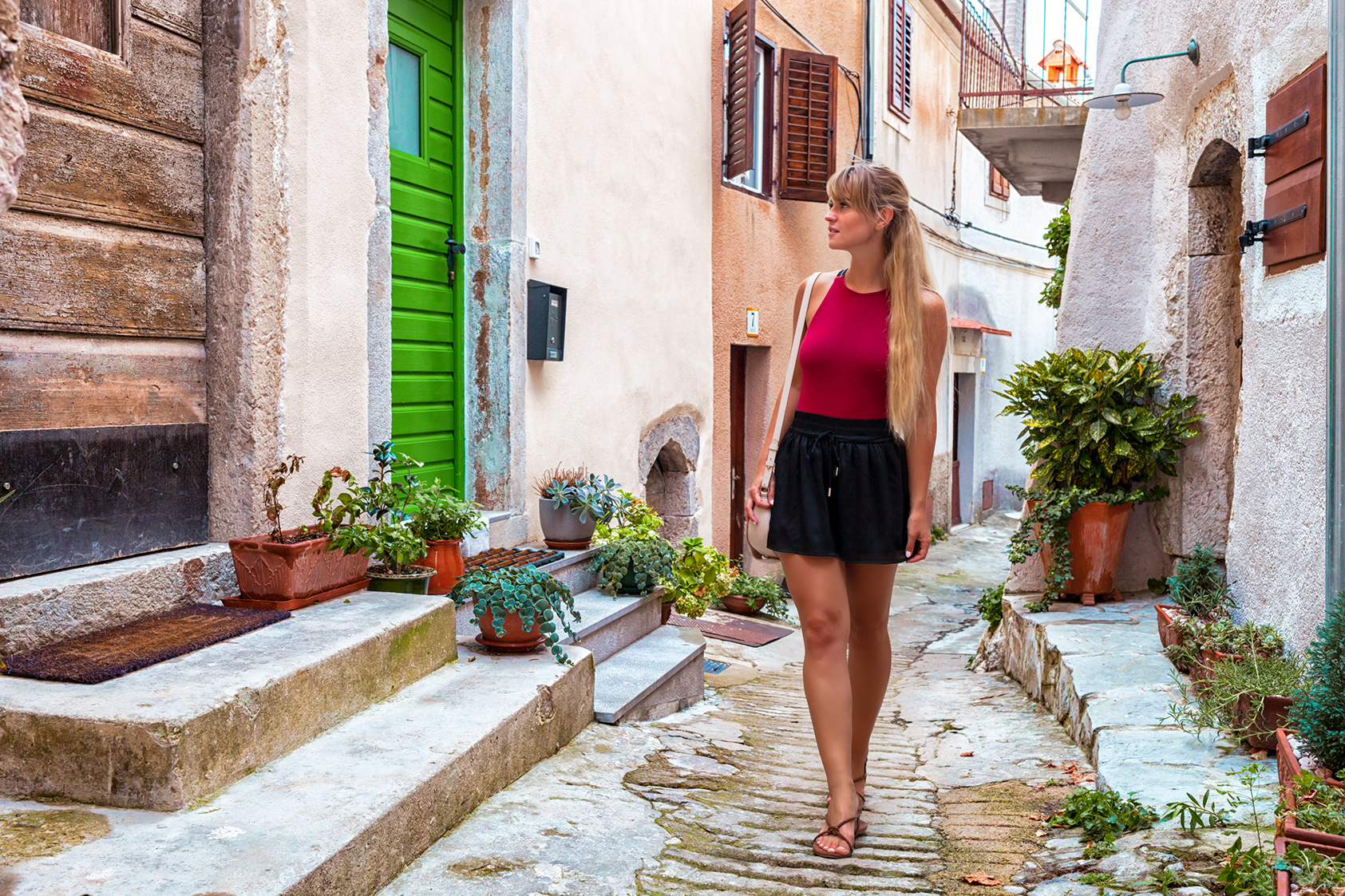
There’s a particular pleasure to arriving in Labin on foot. The road winds up through Podlabin — the newer, lower part of town where most locals actually live — and then the old town appears above you, its walls and bell tower rising out of the ridge like something from a different era. Walk through the gate and the pace changes immediately. The lanes are too narrow for cars. The stone is old enough to have a texture. There’s a café or two, a handful of small galleries, a church you’ll want to look inside.
Labin’s old town is compact — you could walk its full perimeter in twenty minutes — but it rewards slowness. The Labin Town Museum, housed in a Baroque palace, is one of the better small regional museums in Istria, with a collection that covers everything from prehistoric finds to the town’s long history as a coal-mining centre. The mining story is unexpectedly interesting: Labin was the site of a significant workers’ uprising in 1921, when miners took over the town and declared a short-lived “Republic of Labin” in protest against wage cuts and fascist interference. That episode is local legend here, and the museum tells it well.
Beyond the museum, the real joy of Labin old town is simply walking it. The Fortica viewpoint at the top of the hill is one of the best viewpoints in this part of Istria — on a clear day you can see the islands of Cres and Lošinj across the Kvarner Gulf. The Church of the Nativity of the Virgin has a Venetian-era façade and a plain, peaceful interior. Small galleries tucked into former workshops sell work by local artists. For a full account of what’s worth seeing, the cultural heritage of Labin goes into much greater depth on each landmark.
One practical note: the old town’s restaurants and cafés are better than their settings might lead you to expect. Don’t just stop for coffee — plan lunch here. Istrian cooking — truffle pasta, slow-braised meat, local wines — is done well at several spots, and you’re paying old-town prices without the old-town mark-ups you’d see in Rovinj.
The Road Down to Rabac

The drive from Labin to Rabac is short but theatrical. The road drops steeply through pine and scrub forest, switching back twice before the bay comes into view below — first a glimpse of blue between the trees, then the whole thing opening up as you reach the bottom. It’s one of those arrivals that makes you feel like you’ve earned something.
This descent also marks a genuine change in character. Labin is a town of stone and history; Rabac is a town of water and light. The architecture shifts — here it’s the low, whitewashed buildings of a resort village rather than Venetian stone, and the streets lead towards the sea rather than upward to viewpoints. The two places look at each other from a distance, connected by a single road, each the other’s counterpoint.
The walk between them, if you’re inclined, takes roughly 45 minutes one way — downhill is pleasant, uphill in summer heat less so. There are buses connecting the two, which most visitors use for the return journey. A few accommodation properties in Rabac offer shuttles up to Labin in the evenings, which solves the logistics of having dinner in the old town without worrying about the drive back.
Rabac: A Bay That Rewards the Patient Traveller

Rabac has been a seaside resort since the late 19th century, when Viennese and Triestine visitors began arriving in search of the Adriatic sun. That heritage gives it a certain quiet respectability — it’s never been a party resort, never had the high-rise sprawl of larger Croatian tourist destinations. Even at peak season, its character remains predominantly family-oriented and unhurried.
The beaches are what most people come for, and they deliver. The main beach in front of the town is pebble and gravel, sloping gently into water that is remarkably clear for a bay with a busy marina. The water colour — a blue-green that shifts depending on the light — is what people photograph, and the photographs don’t lie. Children wade here safely; snorkellers find enough to keep them entertained. Girandella beach, a short walk north of the town centre, is larger and better shaded, popular with families staying at the nearby resort complex.
South of the main beach, the coastline becomes rockier and quieter. A path follows the shore for several kilometres, passing small coves that are accessible only on foot and largely unknown to day-trippers. The village of Ravni, reached by walking south along the coastal path or by car from Labin, is one of these quieter alternatives — a small cluster of houses, a few apartments, and a bay that rarely fills up even in summer.
For full information on when to visit Rabac and what to expect from each season, there’s a dedicated guide that covers the summer crowds, spring and autumn conditions, and why some travellers actually prefer the shoulder seasons.
Outdoor Activities: Beyond the Beach

The Labin-Rabac area is substantially more active than its reputation suggests. The surrounding hills and coastline are well-suited to cycling and walking, and the bay itself has a reliable wind pattern that makes it popular with water sports enthusiasts.
On the water, Rabac offers kayaking, stand-up paddleboarding, and boat rentals through several operators based on the marina. Kayaking south along the coast is a particularly good way to reach the more isolated coves that can’t be reached by road — paddling for an hour will get you into almost entirely empty bays, with the hills of Istria rising behind you and nothing but the Adriatic ahead. Snorkelling gear is widely available for rent, and the rocky southern sections of the coastline have enough marine life to make it worthwhile.
On land, the cycling routes around Labin connect to Istria’s broader network of marked trails. The terrain here is hillier than the western part of the peninsula, which makes it more rewarding for experienced cyclists and more challenging for casual riders. Several routes run through the interior, passing through villages like Sv. Martin and Sv. Nedelja, where the landscape opens into olive groves and vineyards. For anyone wanting a detailed overview of what’s possible, the guide to outdoor activities in Rabac covers hiking, cycling, water sports, and more in full.
Walking the coastal path between Rabac and the coves to the south is accessible to anyone in reasonable fitness — the terrain is uneven but not steep, and the rewards along the way are consistent. Early morning is the best time to go, before the day’s heat sets in and before the pebble beaches start filling up.
Hidden Coves and Day Trips Worth Making

One of the area’s lesser-known assets is the collection of small bays scattered along the coastline north and south of Rabac. These aren’t signposted, don’t appear prominently on tourist maps, and many can only be reached on foot or by boat. That’s precisely what makes them worth the effort.
North of Rabac, the coastline between the town and the bay of Prtlog passes through a stretch that’s largely undeveloped. Prtlog beaches are among the most consistently recommended by visitors who know the area — shallow, quiet, and set against a backdrop of pine forest that provides shade even in the afternoon. The access road is rough, which effectively filters out casual visitors. A full guide to exploring Prtlog covers what to bring, how to get there, and what to expect from the different sections of the bay.
Further inland from Labin, the town of Raša is worth a detour for anyone interested in 20th-century history and architecture. Built by Mussolini’s government in the 1930s as a model company town for coal miners, it’s a strange and compelling place — the architecture is unmistakably fascist-era Italian, the church resembles an upturned ship in a deliberate reference to the town’s industrial identity, and the whole settlement still feels like an experiment preserved in amber. It’s not on most tourists’ radars, but it should be.
For a broader road trip or those driving to Croatia through Trieste and down the peninsula, the Labin-Rabac area sits conveniently along the route, making it a natural stopping point rather than a detour.
Practical Information: Getting There and Getting Around
Labin and Rabac are reached most easily by car. The town sits on the eastern side of the Istrian peninsula, roughly equidistant from Pula to the south and Rijeka to the northeast. From Pula airport, the drive takes around 50 minutes. From Rijeka, allow about 40 minutes. From the main Istrian highway interchange at Poreč or Pazin, Labin is around 45–60 minutes away depending on your route.
There is public bus service to Labin from both Pula and Rijeka, with reasonable frequency in summer. The connection from Labin down to Rabac is served by a local bus that runs several times daily during the tourist season — a useful option if you want to leave the car in Labin and walk or bus down to the beach.
Parking in Labin’s old town is restricted — the centre itself is car-free, and the main parking area is just outside the old town walls. In summer this fills up by mid-morning, so arriving early pays off. In Rabac, parking is available along the waterfront and in a designated area above the town, though space gets tight in late July and August.
If you’re planning a longer stay and want to use Labin-Rabac as a base for exploring the eastern coast, a car is effectively essential — the coastal coves and inland villages aren’t reachable any other way. Most rental car companies in Pula can arrange drop-off and collection arrangements for visitors who want to avoid driving the full highway network.
Where to Stay: Choosing Between Labin and Rabac

The choice of where to base yourself shapes the whole experience of the area. Both towns have distinct advantages, and the right answer depends on what kind of holiday you’re after.
Staying in Labin old town puts you in the middle of the best walking, dining, and atmosphere the area has to offer. There are a limited number of accommodation options within the walls — apartments converted from old stone buildings, mostly — and they tend to book up early in summer. The tradeoff is that you’ll need to drive or take the bus down to the beach each day, which adds a step but also preserves the sense of the two places as genuinely separate experiences.
Staying in Rabac means waking up with the sea right there — the sound of the water, the early-morning light on the bay, the ability to walk to the beach before breakfast. The resort has a full range of accommodation, from large hotel complexes to small family apartments overlooking the marina. For families with young children, Rabac’s convenience and child-friendly beaches make it the obvious choice. The evening walk or drive up to Labin for dinner becomes a pleasant ritual rather than an obligation.
There’s also a third option: properties in the hills between the two towns, or along the coastal stretch toward Ravni and Prtlog, offer the best of both worlds — proximity to the sea without being in the thick of the resort, and easy access to Labin by car. These tend to be private villa rentals or smaller apartment complexes, and they’re worth looking at if you want space and quiet alongside the beaches.
Why This Corner of Istria Deserves More Credit

Istria has no shortage of beautiful places — the problem isn’t finding somewhere good, it’s narrowing down the options. What sets Labin and Rabac apart isn’t that they’re better than Rovinj or more dramatic than Pula. It’s that they offer something those bigger names can’t: the experience of discovering a place that hasn’t been smoothed flat by mass tourism.
The old town of Labin still functions as a real town — people live there, there are local shops alongside the tourist ones, and the cafés are full of residents as well as visitors. Rabac is a resort, but a measured one: the scale is human, the atmosphere is relaxed, and the water quality is as good as anywhere on the Adriatic. The surrounding coastline still has quiet stretches that reward the effort of seeking them out.
If you’re planning a trip to Istria and wondering whether to push east, the answer is yes. Add a night or two in this part of the peninsula. Walk the Labin old town in the morning and swim at Rabac in the afternoon. Take the coastal path south toward Ravni. Drive up the hill for dinner and watch the sun drop behind the Kvarner islands. It’s one of those combinations that’s greater than the sum of its parts — and it’s still, for now, one of Istria’s better-kept secrets.